
Watch: How I Barbell Row
Here’s the movement in practice. The video shows my bent-over barbell row setup and execution; the full guide below breaks down the hinge, brace, elbow path, torso angle and the way I control each rep.
Barbell rows are one of the bread-and-butter exercises of bodybuilding and strength training.
When I was training in my garage, my training was incredibly basic.
Barbell rows. Single-arm dumbbell rows. Overhead press. Deadlifts. Bench press.
That was pretty much the backbone of it.
Mostly big compound movements, and you can build a hell of a lot of muscle and strength around exercises like those without needing a gym full of machines.
Today, though, I want to concentrate specifically on the bent-over barbell row and how I personally do it.
How I Set Up for a Barbell Row
The way I start a barbell row is actually quite similar to the way I start a deadlift.
I get my feet set underneath the bar, with the bar roughly over the middle of my foot around the shoelace area.
I brace myself, get hold of the bar and deadlift it into a standing position.
If you've read my guide on how I deadlift, the initial setup will already feel familiar.
Once I'm standing with the bar, that's when I move into my rowing position.
I push my hips backwards.
My arms stay straight while I hinge, and I keep a slight bend in my knees.
I'm not thinking about simply folding my back forward. I'm thinking about pushing my hips backwards while keeping myself braced.
That basic idea — hinging at the hips, maintaining a stable back position and keeping some bend in the knees — is also consistent with established bent-over-row technique guidance.[1]
What Angle Do I Use?
This is where you'll see loads of different versions of the bent-over barbell row.
Some people get their torso almost parallel with the floor.
Other people stay much more upright.
I normally sit somewhere between the two.
I'm not stood almost vertical, but I'm not completely horizontal either. If standing upright is one end and being parallel with the floor is the other, I'm roughly somewhere around halfway.
That's where I personally feel strongest and where I feel my back working properly.
There isn't one magical torso angle that everybody has to copy.
Changing your torso position, elbow path and the relationship between your upper arm and torso changes the mechanics of a rowing movement. Research looking across pulling exercises suggests that this relationship can influence how muscular load is distributed.[4]
That's one reason different row variations can feel very different even though they're all fundamentally pulling movements.
How I Perform the Barbell Row
Once I'm in position, I let the bar hang underneath me with my arms extended.
At the bottom, I want to feel the stretch through my lats and back without losing my brace or letting my torso collapse.
Then I row.
The easiest way I can describe what I'm thinking about is:
Drive the elbows behind the body.
Instead of thinking about simply pulling the bar upwards with my hands, I imagine my elbows travelling backwards behind me.
As I pull, I tighten my back and bring the bar towards my body.
For my normal barbell row, I generally pull the bar towards roughly the belly-button area.
Once it reaches my body, I squeeze the back and then lower the weight under control until my arms are extended again.
Then I go again.
For me, the movement is basically:
Stretch. Pull. Elbows back. Squeeze. Control it down.
Pulling a bent-over row towards the abdominal area while maintaining the hinged position is also consistent with established exercise-technique guidance.[1]
Don't Turn Every Rep Into a Full-Body Swing
There's obviously going to be some movement when you start rowing genuinely heavy weights.
But there's a difference between moving a heavy bar and turning every repetition into some sort of deadlift-row hybrid.
When I'm doing normal bent-over rows, I like the movement to stay controlled.
I want to actually feel my back doing the work.
I'd rather use a weight I can control than throw another 20kg on the bar and spend the entire set trying to launch it towards my stomach.
Especially if I'm using the row as more of a bodybuilding movement.
There's another reason I take my position seriously as the weight gets heavier.
A laboratory study comparing the standing bent-over row with an inverted row and one-arm cable row found that the bent-over row produced substantial activation through the back, but it also created the highest lumbar-spine loading of the three exercises tested.[2]
That doesn't mean barbell rows are automatically dangerous.
It does mean I'm not casual about my brace and position when I'm holding a heavy bar in a bent-over stance.
Different Barbell Row Variations
One of the reasons I like rows is that you can alter them in quite a few ways.
You can change your torso angle.
You can change your grip.
You can change where you're pulling the bar towards.
You can row in a slower, controlled style or use a more explosive variation.
Pulling slightly higher towards the torso feels different to me than pulling lower towards the stomach.
Likewise, being more upright feels different to rowing while almost parallel with the floor.
That doesn't mean moving the bar a couple of inches suddenly isolates a completely different muscle.
The back and shoulder muscles work together during rowing movements.
Research into pulling exercises also shows that apparently small changes in things such as shoulder position and the relationship between the arm and torso can alter measured muscle activation.[4]
So for me, changing an angle isn't about pretending I've discovered a completely different exercise.
It's just a way of changing the movement slightly and seeing where I personally feel it best.
Bent-Over Barbell Row vs Pendlay Row
Another variation I'll occasionally use is the Pendlay row.
This is different from the continuous bent-over row I've just described.
With a Pendlay row, I bend much further over and the bar returns to the floor between repetitions.
Every rep starts from a dead stop.
You set yourself, row the bar from the floor, return it to the floor and reset.
I think of them slightly differently.
My normal bent-over row is more of a controlled, continuous movement.
The Pendlay row is more explosive, with every repetition starting again from the floor.
Both are rowing movements, but when you're actually doing them, they feel very different.
The Time I Nearly Fired the Bar Sideways
I remember one time doing barbell rows when I hadn't set my feet properly.
One foot had somehow ended up slightly in front of the other.
As I came up with the row, the bar caught around the top of my knee and suddenly shot sideways.
When you're holding a loaded bar while bent over, having it suddenly travel sideways isn't exactly ideal.
I twisted awkwardly and I'm pretty sure I ended up out of proper training for about a week afterwards.
So as basic as this sounds:
Set your feet properly before you start.
Make sure they're stable.
Make sure you're balanced.
And don't rush the setup because it's an exercise you've done a thousand times.
Some of the stupid injuries I've picked up haven't happened because I didn't know how to perform an exercise.
They happened because I stopped paying attention to something basic.
What Muscles Does the Barbell Row Work?
This is one of the reasons I rate the barbell row so highly.
It's not just one tiny muscle doing all the work.
Research comparing rowing exercises has found substantial muscular activity across the back during the standing bent-over row.[2]
Another study comparing free-weight bent-over rows with cable and machine rows found particularly high activation of the spinal erectors during the free-weight version, showing just how much work your trunk is doing to maintain that position as well.[3]
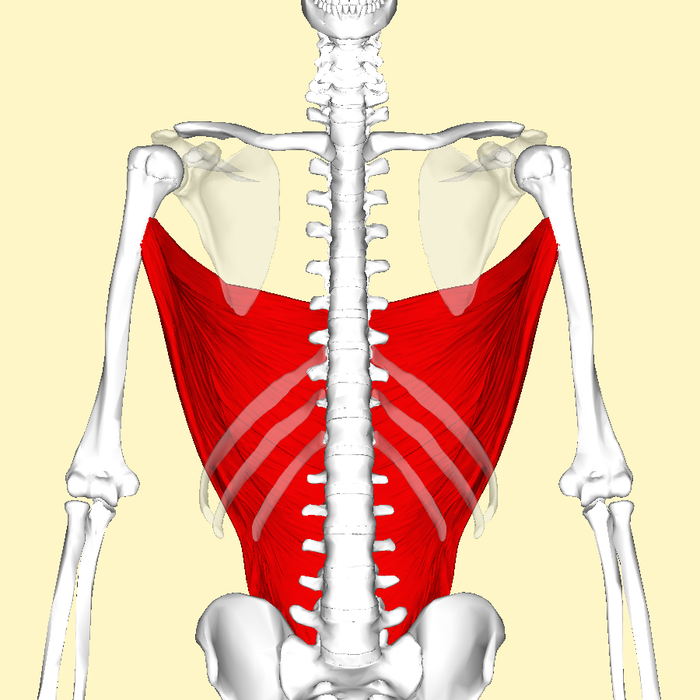
The lats are heavily involved in pulling movements, while the upper-back, shoulder and arm musculature all contribute to the movement and control of the shoulder and elbow.[2][4]
So you're not just moving the bar with your arms.
You're rowing while your body is also having to keep a loaded bent-over position stable.
That's a lot of work coming from one exercise.
One thing worth mentioning is that most of this research measures things like muscle activation, not long-term muscle growth. EMG results can help us understand what is working during an exercise, but they don't automatically prove that one variation will build more muscle over months or years.[4]
Why Barbell Rows Have Always Stayed in My Training
I've trained in commercial gyms.
I've trained in garages.
I've done bodybuilding-style programmes, strength programmes and periods where I've experimented with far too much stuff.
The barbell row keeps coming back.
For me, some form of rowing movement belongs alongside the other basic movements like pressing, squatting and deadlifting.
You don't need forty different exercises to build a strong back.
Sometimes a barbell and years of progressively getting better at the basics will do a hell of a lot.
That's how I barbell row.
I'm not saying it's the only way to do it.
It's simply the way I've learned to do it after years of training, experimenting and occasionally firing a barbell sideways because I couldn't be bothered setting my feet properly.
References
1. American Council on Exercise (ACE). Bent-Over Row — Exercise Library. Exercise-technique guidance covering the hip hinge, slight knee bend, stable back position and controlled rowing movement.
2. Fenwick, C.M.J., Brown, S.H.M. & McGill, S.M. (2009). Comparison of Different Rowing Exercises: Trunk Muscle Activation and Lumbar Spine Motion, Load, and Stiffness. Journal of Strength and Conditioning Research, 23(2), 350–358. DOI: 10.1519/JSC.0b013e3181942019.
3. Saeterbakken, A., Andersen, V., Brudeseth, A., Lund, H. & Fimland, M.S. (2015). The Effect of Performing Bi- and Unilateral Row Exercises on Core Muscle Activation. International Journal of Sports Medicine, 36(11), 900–905. DOI: 10.1055/s-0034-1398646.
4. Di Fonza, D. et al. (2026). Electromyographic Analysis of Latissimus Dorsi Activation During Common Resistance Training Exercises: A Narrative Review. Journal of Functional Morphology and Kinesiology, 11(3), 315. DOI: 10.3390/jfmk11030315.
Training note: This article explains how I personally perform the exercise based on my own training experience. It isn't individual coaching. If you're new to barbell rows, start light enough to learn the movement properly before worrying about how much weight is on the bar.

Comments
Leave a comment
Your email address will not be published. Comments may be reviewed before appearing.