
Introduction
We've all started from practically nothing in the gym. There was a time when I struggled to bench press 40 kg, and even weights lighter than 12 kg were a challenge for me. I had absolutely no clue where to start, what to do or how to approach training.
Fortunately, I had an experienced training partner at the time who helped guide me through those early stages. Without that support, I honestly wouldn't have known where to begin. But not everyone has the advantage of someone experienced showing them the ropes.
So, let's break down exactly where to start, how to recognise a suitable weight and when you should consider increasing it.
Learning the Basics Before Increasing Weight
First things first, I generally advise beginners to familiarise themselves with the fundamentals of free weights and barbells before attempting heavier loads. Understanding the basic movements, developing control and becoming comfortable with the equipment should always take priority over how much weight you're lifting.
However, I've trained with people in the past who simply didn't have the strength to move an empty barbell yet. That's worth recognising because learning the basics with a barbell is only practical if you have the physical ability to handle it in the first place.
There's absolutely nothing wrong with starting on a machine or using lighter dumbbells instead. If you're unsure which equipment to use, see our guide to free weights versus machines. Everyone starts at a different level, and your starting weight should reflect your current ability rather than what you think you should be capable of lifting.
Getting Familiar with Gym Machines
When using resistance machines, the first thing I recommend is checking the instructions. These are usually displayed somewhere on the machine itself and explain which muscles it targets and how to use it correctly.
Most machines also have adjustable components, often operated using spring-loaded pins, pull-out knobs or screw-style mechanisms. These allow you to adjust things such as the seat height, handle position, starting position or range of movement to suit your body.
Take a moment to familiarise yourself with each machine before using it. Read the instructions, understand what the machine is designed to do and make sure it matches the muscle group you're intending to train.
Once you've identified the correct machine, adjust it to a comfortable position that allows you to perform the movement with control and without forcing your joints into an awkward position. If you're unsure how to adjust or operate a machine, ask a member of gym staff to demonstrate it.
Choosing Your Starting Weight
My personal preference when training for bodybuilding is to choose a weight that I can comfortably manage for around eight repetitions, with the ninth and tenth repetitions becoming noticeably more challenging. By those final repetitions, I want to feel that I'm having to work harder to complete the movement while still maintaining proper technique and control.
For muscular endurance training, I take a different approach. I generally aim for around 15–20 repetitions using a lighter, more manageable weight. During these sets, I would usually expect the muscles to start feeling the effects of fatigue somewhere around the twelfth repetition, with the remaining repetitions becoming progressively more demanding.
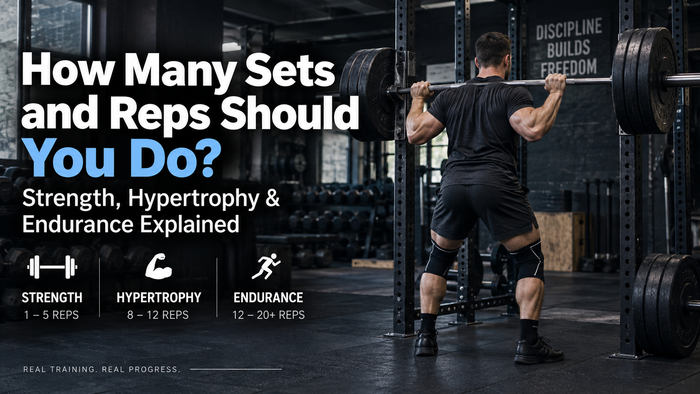
These are my personal training preferences rather than fixed rules. For a fuller explanation of different repetition ranges, read how many sets and reps you should do. When you're completely new to the gym, the most important thing is finding a resistance that allows you to complete the movement correctly. As your confidence, coordination and strength improve, you can gradually begin challenging yourself with heavier weights or additional repetitions.
A Simple Way to Test Your Starting Weight
Let's say you're using a chest press machine for the first time and you're aiming for ten repetitions. Start with a light resistance and perform a few controlled repetitions to get comfortable with the movement. If the weight feels manageable, try completing your target of ten repetitions.
If you finish all ten repetitions with good technique and feel as though you could comfortably complete several more, you may be able to increase the weight slightly. If you're struggling halfway through the set, losing control or having to force the movement, the resistance is probably too heavy and should be reduced.
What you're looking for is a weight that challenges you without compromising your technique. For your first few sessions, it's perfectly reasonable to finish a set knowing you could have performed a few more repetitions. You can build from there as you become more familiar with the exercise.
Recognising When a Weight Is Too Heavy
Regardless of how heavy you're lifting, your repetitions should remain manageable and controlled. There's a difference between a weight being challenging and a weight being too heavy for you to perform the exercise correctly.
If your technique starts to deteriorate to the point where the movement looks nothing like it should, or you find yourself rocking and swinging your entire body just to move the weight, that's usually a clear indication that you need to reduce the resistance.
The goal is to challenge the muscles you're intending to train, not to use momentum and unnecessary body movement to force out repetitions. A difficult repetition is perfectly acceptable, but sacrificing your technique simply to lift a heavier weight defeats the purpose, particularly when you're still learning the fundamentals.
Knowing When to Increase the Weight
I've always been a firm believer in making my working sets progressively more challenging, particularly as I move into the third and fourth sets of an exercise. From a more structured training perspective, progressive overload involves gradually increasing the demands placed on your muscles over time, whether that's through additional weight, repetitions or improvements in performance, while managing fatigue and recovery.
However, with that in mind, I spent my early years learning to train with a very old-school mentality. I focused on working hard, lifting weights and gradually building my strength through experience rather than following a particularly technical approach to progression.
Even now, I generally judge when to increase the weight by how manageable it has become. If I've been training consistently and, after several weeks or around a month, the weights begin to feel noticeably easier, that's usually when I'll look at increasing the resistance.
If you'd like to explore this further, I've explained what progressive overload actually looked like for me in a separate article. For beginners, the principle is much the same. You don't necessarily need to increase the weight every session. If you can consistently complete your target repetitions with good technique and the exercise is becoming easier, you can consider a small increase while continuing to prioritise control and recovery.
Remember that progress isn't always measured by adding more weight. Completing an extra repetition, improving your range of movement or performing an exercise with better control can all demonstrate that you're getting stronger and more confident.
Final Thoughts
Whether you're starting with free weights, resistance machines, barbells or kettlebells, the most important thing is to begin with a weight you can actually manage. Everyone starts somewhere, and there's absolutely nothing wrong with starting light.
Focus on gradually improving your strength, your technique and your confidence. Progress at a pace that suits your ability, always prioritise safety and remember that lifting heavier weights means very little if you can't control them properly.
For more guidance on getting started, see how to build muscle as a beginner. There's no need for ego lifting here. Train hard, train safely, keep improving and, most importantly, have fun.
Further Reading and Sources
For evidence-based guidance on beginning strength training and progressing safely, see the NHS guide to improving strength and flexibility, which recommends starting gradually and building up over time, and the American College of Sports Medicine's 2026 resistance training guidelines, which emphasise consistency, individual goals and manageable progression.
Comments
Leave a comment
Your email address will not be published. Comments may be reviewed before appearing.