
Right now, I train twice a day.
Before anybody reads that and thinks I’m doing two absolutely brutal workouts every day, I’m not. If I trained in the morning the way I train in the afternoon, I’d probably destroy my afternoon session.
The two workouts have completely different purposes. The morning is about getting moving. The afternoon is where I actually train hard.
My Morning Session
I like going to the gym in the morning because it wakes me up. I’m not trying to break records, reach failure or create significant fatigue. I just want a pump.
If it’s chest and triceps day, for example, I’ll do cable flyes, machine press, light barbell press, rope pushdowns and triceps extensions. Very light weight and plenty of repetitions.
The objective is simple: feel the muscle working, get a slight pump and leave. If I start turning that into a proper workout, I’ve missed the point.
Then I Get Out of the Gym
I go home, shower and take my dog out for around an hour. I’ll then eat something relatively light because I don’t particularly enjoy going into a heavy training session with loads of food sitting in my stomach.
Then I leave it for several hours. Around 2pm, I’m back. Completely different session.
Headphones Go In and the Weight Goes Up
This is the session I care about performing in.
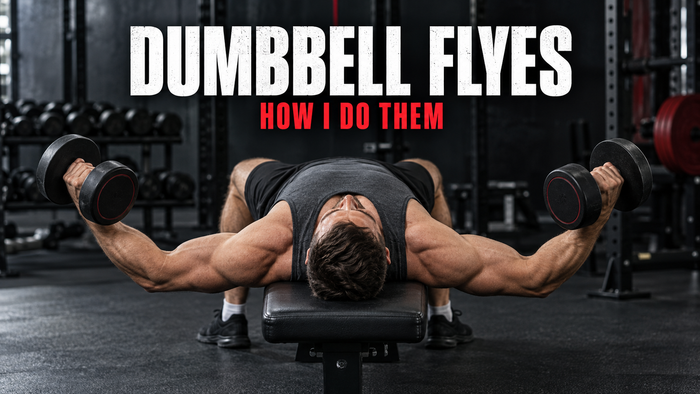
Using chest and triceps again, I’ll start with heavy flat bench press, then heavy incline dumbbell press. After that I’ll use dumbbell flyes, starting flat and then changing the bench angle rather than going all the way to a full incline.
I’ll finish with close-grip bench press and bodyweight dips.
There’s still isolation work in my current training, but nowhere near the mentality I used to have where I’d just keep adding exercises until the muscle was completely annihilated. Get the important work done, a little bit extra, then go home.
Why Split It Into Two Sessions?
The simplest answer is because I enjoy it. I’m also bigger now than I’ve previously been and I’m happy with how my current training is going.
But me getting bigger while training twice a day doesn’t prove that training twice a day made me bigger. That’s an easy trap to fall into with fitness. Change something, get a result, attribute the entire result to the thing you changed.
My overall training, nutrition, recovery, bodyweight and years of experience all matter. I also wouldn’t tell somebody that they need to train twice every day to build muscle. They don’t.
The Hardest Part Is Probably Holding Back
This sounds ridiculous considering it’s a workout, but sometimes doing very little is harder than doing more.
I’ve spent years training hard. Once you get a pump and start feeling good, there’s always the temptation to put another plate on or start adding exercises. But then I’ve turned my pump session into a workout, and I’ve still got to come back later and bench heavy.
So my rule is essentially: pump without fatigue.
Whether there’s a meaningful physiological advantage to doing that compared with simply doing my heavy session later is something I’m much less certain about. It might help me feel physically ready, it might primarily help me mentally, or it might simply be a routine I enjoy that doesn’t interfere significantly with my proper training.
Then Recovery Starts Again
After the heavy session I’ll go home, usually have a salt bath and later walk my dog again. My first substantial meal of the day tends to come around 5pm.
Then the next day I move onto the next part of my normal split: chest and triceps, back and biceps, shoulders and abs, legs, then repeat or back off depending on how I’m feeling.
If you’re deciding how often to train, see How Many Days a Week Should You Train to Build Muscle? Recovery still matters too, so I’ve also linked my complete workout recovery guide.
What Does the Research Say?
This is where I need to separate what I know from what I feel.
I know that I enjoy training this way. I know that I’m currently bigger than I’ve previously been. And I know that the light morning session makes me feel ready to train.
What I can’t honestly say is that the morning pump is the reason I’ve grown.
Training frequency on its own isn’t magic. Reviews suggest that when weekly training volume is matched, simply training a muscle more often does not automatically produce more hypertrophy. Frequency is better thought of as one way to organise useful weekly work around performance and recovery.[1]
That’s why I deliberately keep my morning session light. I’m not trying to take exercises to failure or sneak another full chest workout into the day. I want movement and a pump without arriving at my heavy session already knackered. Training to complete failure is not required for muscle growth, and doing so can add fatigue without reliably producing better results.[2]
Could I put everything into one session and still build muscle? Absolutely. Nobody needs to train twice a day simply because I currently do.
Would I Recommend Training Twice a Day?
Not automatically. If somebody is already struggling to recover from four workouts a week, giving them another four sessions probably isn’t the solution.
This is simply where my own training has ended up after years of trying different approaches. I’ve done massive-volume bro splits, spent years doing 5x5, concentrated on Olympic lifts, trained for abs, tried push pull legs and trained around aesthetics.
You can read that whole progression in How My Training Changed Over the Years.
Somehow I’ve ended up back at the bro split, except now I go into the gym in the morning and deliberately hold myself back so I can return several hours later and do the exact opposite.
It sounds slightly mad when I write it down. But right now I’m enjoying my training, I’m getting bigger, and it’s working for me. That’s enough reason for me to keep experimenting with it.
Research & Sources
- Schoenfeld BJ, et al. — Effects of resistance training frequency on measures of muscle hypertrophy. Systematic review and meta-analysis.
- Grgic J, et al. — Resistance training performed to repetition failure or non-failure. Systematic review and meta-analysis.

Comments
Leave a comment
Your email address will not be published. Comments may be reviewed before appearing.