
I’m very big on how I look and how I perform, and over the years what I’ve wanted from the gym has changed constantly.
There have been periods where I wanted to be massive. Other times I wanted to lose weight. Sometimes I couldn't care less what the scales said because all I wanted was that next deadlift or bench press.
It depends where I am in my training and, realistically, where my head is at as well.
There’s a psychological side to training that I don’t think gets spoken about enough either. Body confidence, becoming overly conscious of how you look, feeling smaller when you haven't trained, feeling flat when you're dieting, even just feeling restless when you've missed the gym for a few days.
It can all affect you.
I've gone through enough periods of gaining and losing weight now that I've picked up a few things that make getting leaner much easier for me.
Nothing revolutionary.
Nothing involving starving yourself.
Mostly just little changes that add up.
Start With the Calories You Barely Notice
One of the first things I do when I'm trying to lose weight is look at the stupid calories.
Chocolate, snacks, drinks, sauces — the things you barely even register as part of your diet.
I used to think dieting meant cutting sugar out completely.
I don't really look at it that way anymore.
If I want a chocolate bar, I'll have one. But instead of automatically grabbing a massive one, I might compare the calories and pick a smaller wafer-style bar or another alternative.
I'm still having something sweet.
I haven't told myself I'm never allowed chocolate again.
I've just saved some calories.
Obviously, swapping one chocolate bar isn't going to suddenly make you lean.
But save 100 calories here, another 100 somewhere else, do that consistently across weeks and those little changes start to matter.
That's something I've learnt about losing weight:
You don't always need to remove foods. Sometimes you just need to change the amount.
Intermittent Fasting Was a Godsend for Me
I've tried loads of diets, but intermittent fasting has probably been one of the easiest ways for me personally to control my food.
I want to be clear about why, though.
I don't think fasting magically burns fat.
For me, it simply gives me fewer hours in which to eat.
My usual eating window has been roughly 2pm until 10pm.
I don't bother with breakfast. I'll train in the morning, walk the dog, go to work or get on with whatever I'm doing, then around 2pm I'll start eating.
Usually that's something high in protein.
I'll eat throughout the afternoon and evening, keeping things relatively sensible, and then somewhere around 9:30pm I'll normally have my biggest meal.
Then I'm done.
That works incredibly well for me because I'm much less likely to accidentally eat too much.
Someone else might absolutely hate it.
That's fine.
Research comparing intermittent fasting with continuous calorie restriction finds broadly similar weight-loss effects overall; fasting can work, but it does not appear to have a universal fat-loss advantage simply because the eating window is shorter.[1]
So I don't see intermittent fasting as magic.
I see it as a tool.
If shortening your eating window makes controlling your food easier, brilliant. If it makes you miserable, use something else.
Calories Still Matter
You can make dieting incredibly complicated if you want to.
Low carb.
High carb.
Keto.
Fasting.
Carnivore.
Meal timing.
Insulin.
Fat-burning foods.
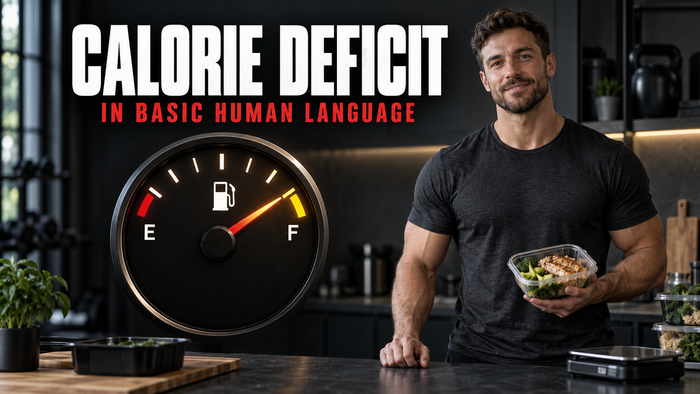
But when we're specifically talking about losing body weight, you still have to come back to energy balance. The NHS describes weight loss in the same basic terms: taking in fewer calories than your body uses over time creates the energy deficit needed for weight loss.[2]
Your body uses energy constantly.
That includes keeping you alive, digesting food, walking around, doing your job, training, walking the dog and everything else you do throughout the day.
The amount of energy you need to maintain your weight across all of that is roughly your total daily energy expenditure, or TDEE.
That's different from your resting metabolic rate, which is roughly what your body requires to keep functioning at rest.
If, over time, you consistently consume less energy than you're using, your body weight will generally trend down.
Consume more than you're using and it'll generally trend up.
It isn't perfectly mathematical from day to day because body weight fluctuates through water, glycogen, food in your digestive system and plenty of other things.
Your energy requirements can also change as your body weight changes.
But the principle still stands.
I also don't personally track every macro. If you want to see how I manage food without obsessing over every number, read I Don’t Actually Track My Macros — Here’s What I Do Instead.
I Prefer a Modest Deficit
I don't see the point in immediately destroying your calories.
Let's say I've estimated that I'm maintaining my current weight at around 2,700 calories.
Instead of suddenly deciding I'm going to survive on 1,400 calories, I might start somewhere around 2,400.
That's an example, not a prescription for everyone.
Then I watch what happens.
I don't panic because the scales went up one morning.
I look at the trend.
If my weight is gradually coming down, I'm still training well, I'm not constantly starving and I can actually stick to the diet, brilliant.
Why make it harder?
If nothing is happening after enough time to actually judge it, then I can adjust.
This is one of the biggest differences between how I used to diet and how I diet now.
I used to think:
More suffering = better diet.
Now I think:
What's the smallest change I can make that keeps me moving in the right direction?
Weight Loss and Healthy Eating Aren't Exactly the Same Question
Years ago I remember hearing about what became known as the Twinkie diet.
A nutrition professor called Mark Haub deliberately restricted his overall calorie intake while eating a large amount of processed snack food, including things like snack cakes, and lost a significant amount of weight.
It's an interesting example, but it gets misunderstood.
It doesn't prove that eating Twinkies all day is healthy.
It definitely doesn't mean I'd recommend doing it.
And one man's experiment isn't enough to establish an ideal diet.
What it demonstrates quite nicely is that losing body weight and eating a nutritionally good diet are not exactly the same question.
You could lose weight while eating a poor-quality diet if your energy intake was low enough.
You could also gain weight eating nutritious foods if you're consistently consuming more energy than you use.
But food quality still matters for health, training performance, recovery, fibre, vitamins, minerals, hunger and generally feeling like a functioning human being. UK healthy-eating guidance still recommends a varied diet built around fruit and vegetables, higher-fibre starchy foods, protein foods, dairy or alternatives and appropriate fats rather than judging a diet only by calories.[3]
If you want a broader check of food quality rather than just calories, I've also written Is Your Diet Actually Healthy?.
So when I'm dieting, I want both.
I want enough control over my calories to lose fat, but I also want most of my food to actually provide something useful.
Lift Weights
This probably isn't going to surprise anyone who has read much of Kravix.
I'm always going to promote lifting weights.
When I'm dieting, I don't suddenly abandon the weights and spend two hours a night on a treadmill.
One of my priorities is keeping as much muscle and strength as I reasonably can while the weight comes down.
A 2025 systematic review and meta-analysis found that adding resistance exercise to dietary weight loss helped protect fat-free mass compared with diet alone.[4]
That's important to me because I'm not trying to become the lightest version of myself.
I care about body composition.
If I lose weight but lose loads of muscle with it, I might be lighter on the scales without getting the look I was actually chasing.
I want to lose fat while holding onto as much of the physique underneath it as possible.
Does Having More Muscle Mean You Burn More Calories?
Technically, having more metabolically active tissue does contribute to your body's energy requirements.
But this is an area where gym talk can massively exaggerate things.
Putting on some muscle doesn't suddenly turn your body into a furnace where you can eat whatever you want without gaining fat.
That's not how it works.
Building muscle can contribute to your overall energy expenditure, and carrying a larger body generally costs more energy to maintain and move around.
But I wouldn't build a fat-loss plan around some idea that an extra bit of muscle is going to burn thousands of calories for me.
The main reason I want to maintain muscle while dieting is simpler:
I want to look muscular when the fat comes off.
Any additional energy expenditure is a bonus.
Then Add Some Cardio
I use cardio as an extra adjustment.
Not punishment.
I don't want to spend an hour and a half absolutely smashing cardio, go home starving and then accidentally eat every calorie I've just burned.
I'd much rather train weights properly, stay generally active and add a manageable amount of cardio.
One thing I often do is 10–15 minutes of incline walking after weights.
I'm not claiming that 15 minutes on a treadmill magically strips fat off you.
It doesn't.
It simply increases my activity and energy expenditure a little bit, it's easy for me to recover from, and I can do it consistently.
If you enjoy doing more cardio, do more.
Walk.
Cycle.
Swim.
Box.
Use the stair machine.
Whatever you're actually going to stick to.
And Yes, You Still Burn Energy After Cardio
Something I used to say was that cardio only burns calories while you're actually doing it.
That's not completely accurate.
Energy expenditure can remain elevated after exercise through excess post-exercise oxygen consumption, although the size of that effect varies with the exercise and should not be treated as a huge fat-loss bonus.[5]
For most normal training sessions, the important thing is simply that physical activity contributes to your overall daily energy expenditure.
So I don't look at a treadmill saying I've burned 300 calories and think:
"Brilliant. I've earned 300 calories of chocolate."
For one thing, those calorie estimates aren't perfect.
And secondly, that's a really easy way of turning exercise into a transaction where you're constantly trying to earn food.
I prefer this:
Control the diet.
Keep moving.
Let cardio assist the process.
I've Tried the Stupid Diets as Well
I've done keto.
I've done intermittent fasting.
I've basically starved myself trying one-meal-a-day approaches after seeing things online.
That was horrendous for me.
I've done the stereotypical bodybuilding diet where you feel like you're eating chicken and rice five times a day.
I've bulked.
I've dirty bulked.
I've eaten enormous portions because the objective at the time was simply getting stronger and bigger.
And after experimenting with all these approaches, I've somehow ended up back at something ridiculously simple.
Estimate your calorie needs. Create a manageable deficit. Eat enough protein. Keep training. Stay active. Monitor what happens. Adjust when you need to.
That's basically it.
You Don't Need to Be Scared of Carbohydrates
This is another one where I've changed my thinking over the years.
I used to think about diets much more in terms of:
"Right, I need to cut my carbs."
Now I look at the whole diet.
Carbohydrates don't somehow stop fat loss if you're still in an appropriate calorie deficit.
And if you're training hard, carbs can actually be useful for fuelling that training.
So instead of automatically saying low carb, I'd rather say:
Get enough protein.
Get enough dietary fat.
Eat plenty of nutrient-dense foods.
Get some fruit and vegetables in.
Then fit your carbohydrates into your overall calories in a way that works with your training and preferences.
You don't need to fear rice because you're trying to see your abs.
You just need to remember the rice still contains calories.
Same with fat.
Same with protein.
Same with the supposedly healthy snack that somehow contains 600 calories.
Read the label.
Protein Matters Even More When I'm Dieting
Protein is something I prioritise heavily when I'm trying to lose fat.
Part of that is obvious: I train with weights and I want to maintain muscle.
Protein can also increase short-term feelings of fullness compared with lower-protein intakes, although appetite responses vary and it is not a magic hunger switch.[6]
That doesn't mean more protein is endlessly better.
There's still a point where you've got enough.
If you want the numbers in more detail, I've broken that down in Protein for Muscle Growth: How Much Do You Really Need?.
But I'd much rather build my meals around a decent protein source than spend my entire calorie allowance on foods that leave me starving again half an hour later.
That's why most of my meals when I'm dieting tend to start with:
Where's my protein coming from?
Then I build around it.
Your Maintenance Calories Aren't a Perfect Number
This is another thing that's worth understanding.
People talk about maintenance calories as if everybody has a number stamped on their forehead.
"Mine is exactly 2,713."
Realistically, it's an estimate.
Calculators can give you a starting point.
Your smartwatch can give you information.
Food tracking can give you information.
But the most useful thing is what actually happens to your weight over time.
If you consistently eat roughly 2,700 calories and your average body weight stays around the same, you've learnt something useful.
If you're consistently gaining weight, you're probably above maintenance.
If you're consistently losing weight, you're probably below it.
And as you lose weight, your calorie requirements can change as well.
So calculate it.
Test it.
Watch the trend.
Adjust.
Make the Diet Easy Enough That You Can Actually Live With It
That's probably the biggest thing I've learnt.
The best fat-loss phase isn't necessarily the one where I've suffered the most.
It's normally the one where I've created habits that mean I barely have to think about dieting.
Smaller chocolate bar.
Zero-calorie drink instead of full sugar if I don't care about the difference.
Control my portions.
High-protein meals.
An eating window if that makes controlling food easier.
Keep lifting.
Walk more.
Add a little cardio.
Monitor my weight across weeks rather than losing my mind over one morning on the scales.
Adjust when I actually need to adjust.
You don't get bonus points for suffering.
I've done the extreme versions.
I've starved myself.
I've removed entire food groups.
I've followed diets because somebody on the internet told me they were incredible.
And I’ve also written about what happened when chasing being lean became the goal in itself in I Lost Nine Stone Chasing Abs.
After all of that, I've ended up back at the boring answer.
Eat a little less than you need, eat reasonably well, keep training, stay active and do it consistently for long enough to actually see the result.
For me, that's losing weight the easy way.
Research & Sources
- Intermittent fasting strategies and cardiometabolic outcomes. Systematic review and network meta-analysis of randomised clinical trials, 2025.
- NHS — Calorie counting and weight loss.
- NHS — The Eatwell Guide.
- Effect of resistance exercise during dietary weight loss. Systematic review and meta-analysis, 2025.
- Panissa VLG, et al. — Excess post-exercise oxygen consumption. Systematic review, 2021.
- Dhillon J, et al. — Effects of increased protein intake on fullness. Meta-analysis.
Comments
Leave a comment
Your email address will not be published. Comments may be reviewed before appearing.