
When I’m training I’m a big believer in actually feeling the exercise.
Not just moving the weight because that’s what you’re supposed to do, but actually thinking about the muscle you’re trying to use and what it’s doing while you’re doing the movement.
People call it mind-to-muscle connection.
I’ve heard loads of different explanations for it. People saying you can pump more blood into a muscle by concentrating on it, or that your brain somehow makes that muscle work harder because you’re thinking about it.
There is some research behind the basic idea, but I think it gets exaggerated. Studies have found that consciously focusing on a target muscle can increase its measured activity during some resistance exercises, particularly at lighter-to-moderate loads.[1] One small training study also found greater biceps growth with an internal muscle-focused cue, although the evidence is nowhere near strong enough to say everybody must train this way.[2]
That’s never really been the point for me anyway.
The easiest way I can explain it is a bicep curl.
Say you’re doing a single-arm dumbbell curl.
You’ve got the dumbbell in one hand and your phone in the other.
You’re looking at your phone, not really paying attention, and your arm is just moving up and down.
You’re still doing the curl, but you could be swinging it slightly, using your shoulder more than you realise, or just moving the weight without really thinking about your bicep at all.
Now do exactly the same thing, same dumbbell, same weight, but this time actually think about your bicep.
Feel it stretch at the bottom.
Squeeze it at the top.
Try and make the bicep do most of the work.
Same weight suddenly feels a lot harder.
That’s basically what I mean by it.
You’re not just moving something from point A to point B. You’re thinking about what you’re actually trying to train.
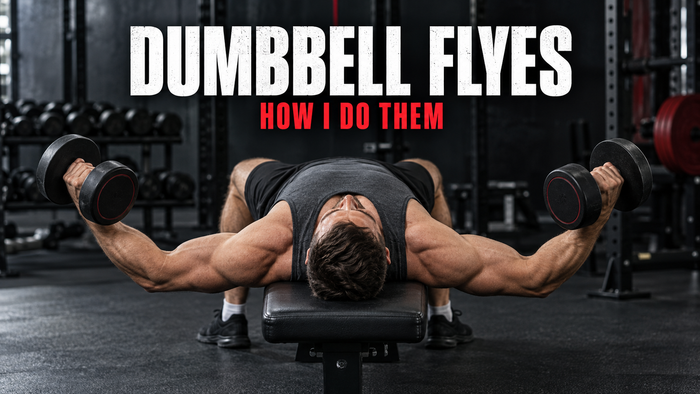
Bench press is another good example.
You can lie down and just think, get this bar up.
And you probably will.
Chest, triceps, front delts, everything is getting involved and doing what it needs to do.
But now do the same movement and actually focus on your chest.
Control the bar down.
Think about the stretch.
Then when you press, focus on the chest doing most of the work.
Obviously your shoulders and triceps are still working because it’s a bench press, but the exercise feels completely different when you’re actually thinking about where you want the work to go.
And I don’t think this only applies to bodybuilding either.
I’ve trained in a lot of different styles over the years, and I use the same sort of thing when I’m lifting heavy.
Take the deadlift.
When I’m trying to get the bar off the floor I’m not just thinking, stand up.
I’m thinking:
Drive your legs through the floor.
That’s the bit I’m concentrating on first.
Then when the bar gets higher and I’m coming towards lockout, the thought changes.
My less technical cue is:
Shag the bar.
😂
Basically squeeze your glutes and drive your hips forward.
So even on something like a deadlift, where you’re obviously using loads of muscles at once, I’m still thinking about what needs to happen at different parts of the lift.
That’s why I think mind-to-muscle connection sounds more complicated than it actually is.
Sometimes it’s one muscle.
Sometimes it’s one part of a movement.
Sometimes it’s literally just one stupid little cue in your head that makes the exercise click.
But for me the main thing is this:
Don’t just move the weight because the weight needs moving.
Think about what you’re trying to make your body do.
You can take an exercise you’ve done hundreds of times, use exactly the same weight, and make it feel completely different just by actually concentrating on the movement.
Research & Sources
- Calatayud J, et al. — Importance of mind-muscle connection during progressive resistance training. Study of selective muscle activation during bench press.
- Schoenfeld BJ, et al. — Differential effects of attentional focus strategies during long-term resistance training. Training study examining internal versus external focus.

Comments
Leave a comment
Your email address will not be published. Comments may be reviewed before appearing.