
Before I get into this, I need to make something clear.
I’m not a personal trainer. I’m not a qualified or registered strength coach, and I’m definitely not a professional bodybuilder.
I’m just a normal guy who loves training.
I’ve spent the best part of ten years doing it, and somewhere along the way I became slightly obsessed with watching training videos, reading books, trying different routines, changing things, making mistakes and figuring out what actually works for me.
So I can’t sit here and tell you the scientifically perfect way to train, because quite frankly I don’t think there is one perfect way for everybody. People are different. We respond differently, recover differently, enjoy different exercises and eventually develop our own way of training.
What I can tell you is what worked for me.
I can tell you how I started, where I started, what I was doing when I was nowhere near as strong as I am now, and hopefully there might be something in there that you can take into your own routine, workouts or general knowledge.
Because when I started, I really was a beginner.
I couldn’t even bench the 22 kg dumbbells.
I’ve actually written before about sitting next to another bloke who was benching a weight that seemed ridiculous to me at the time. I remember looking at my training partner and basically saying:
“I’ll get to that one day.”
At the time, I genuinely didn’t know if I would.
But before all the different strength programmes, training styles and things I’ve experimented with since, there was one basic routine.
It was the routine my training partner originally put me through, and I trained in roughly this sort of way for the first couple of years.
So I don’t really want to call this a beginner training guide.
Yes, I did it when I was a beginner, and somebody starting out could absolutely take ideas from it, but that isn’t really the point of this article.
I want to show you where I started.
Because when you look at what somebody can lift or how somebody trains after ten years, you don’t always see the years before it. You don’t see them struggling with weights that eventually become warm-up sets.
This was part of that beginning for me.
It gave me structure, taught me exercises and gave me something to build from. Then over the years I changed things, experimented and eventually developed my own way of training.
Maybe you’ll take the whole routine.
Maybe you’ll take one exercise.
Maybe you’ll just take an idea from it and use it somewhere else.
Either way, this is where I started.
So let’s get into it.
Day 1 — Chest and Triceps
I’d start with the flat bench press. Aim for around 3–4 sets of 10 reps and use a weight that you know you can control but is still reasonably difficult for you. I don’t mean load the bar up with everything you can possibly move. I mean choose something where the first few reps feel solid but by the time you get towards the end of the set you’re having to work for it.
From there I’d move onto an incline press. One thing I personally like doing is alternating between barbells and dumbbells, so one week I might use the barbell and the following week use dumbbells. Again, I’d keep it straightforward with 3–4 sets of 8–10 reps, using enough weight that the final few reps are becoming difficult without your form completely falling apart.
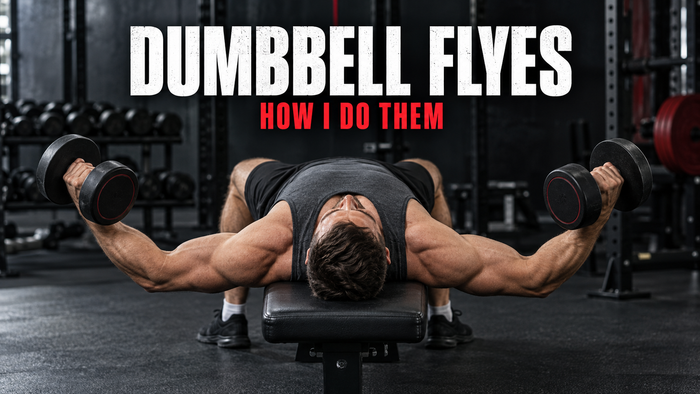
After the pressing I’d move onto dumbbell flys. I like doing both flat dumbbell flys and incline dumbbell flys, usually one after the other, for around 3–4 sets of 10 reps. You don’t need to go stupidly heavy on these. Control the dumbbells, get a good stretch and actually feel your chest doing the work.
The final chest exercise would usually be some kind of machine-loaded chest press. By this point the heavy work is already done, so I’m basically using the machine to finish the chest off without having to concentrate as much on balancing a bar or dumbbells.
Then I’d move onto triceps. I’d keep this pretty simple as well. Dips are a good option, either bodyweight or machine-assisted, followed by things like cable pushdowns, rope pushdowns or triceps extensions using either dumbbells or a machine. You don’t need every variation every session. Pick a few, learn them properly and work with them.
When you’re starting out, I wouldn’t be trying to cram ten different exercises into one muscle group. For something like chest, around four or five exercises is plenty. The whole point of this routine is to give the muscle enough work without making the session so complicated that you don’t even know what you’re supposed to be doing.
Day 2 — Back and Biceps
For back, I like to think from the bottom up. Your back makes up a massive portion of your frame, so compared with some other muscle groups there is going to be slightly more work involved.
First and foremost though: deadlifts.
I’d gradually work up to a weight that feels reasonably difficult for you and then do a few working sets of around 4–5 reps. Personally, I tend to increase the weight in roughly 10 kg jumps as I work my way up. You don’t need to do loads of reps on every single warm-up set though because the point is to prepare yourself for the working weight, not exhaust yourself before you even reach it.
Deadlifts are a massive compound movement and work a huge amount of your body. Quite frankly, there are entire training routines where people specialise heavily in deadlifts and only add a handful of other exercises around them. If you’re unfamiliar with the movement, have a look at How I Deadlift, where I give a basic breakdown of the way I personally approach it.
After the deadlift I start thinking about the back in two dimensions: thickness and width.
Thickness is basically how much back you have when somebody looks at you from the side, while width is what gives you that broader appearance from the front and behind. It always makes me smile when somebody walks towards me looking absolutely massive and then turns sideways and practically disappears. We need to stop that trend.
So first I work on thickness.
After deadlifts I’d normally go into some kind of rowing movement. That could be single-arm dumbbell rows, double-arm dumbbell rows, barbell rows or T-bar rows. I don’t think you have to become obsessed with one exact variation either. One week I might use dumbbells, the next week I might use a barbell and another week I might use a T-bar. Find the movements that feel good for you and learn how to perform them properly.
I’d generally aim for around 3–4 sets of 8–10 reps on the main rowing movement.
Once the bigger compound rows are done, I’ll normally move onto a cable or machine row for around 3–4 sets of 10 reps. At this point you’re still working on that thickness, but you don’t need every single exercise to be another huge compound lift.
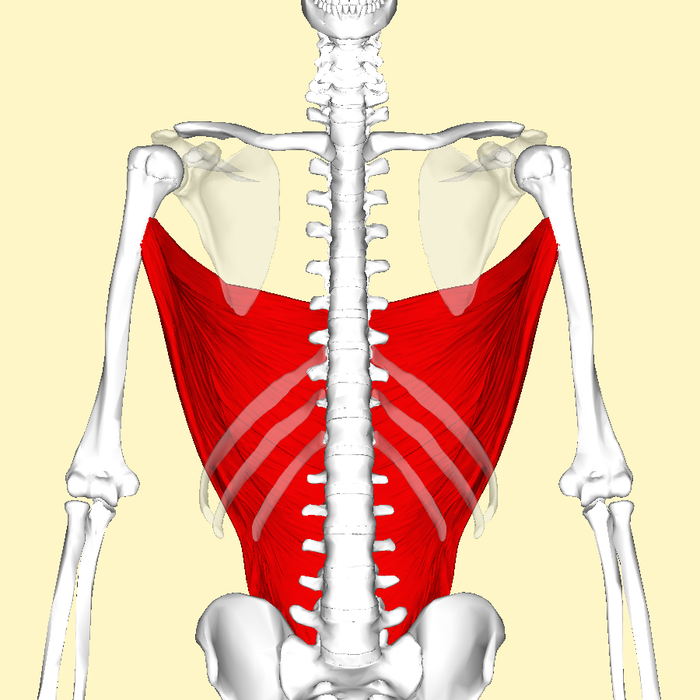
Once the thickness work is finished, I move onto width. This is where the pulldown movements come in. I’ll normally use something like close-grip lat pulldowns for 3–4 sets of 10, followed by wide-grip pulldowns for another 3–4 sets of 10.
To finish the back I might use another lat-pulldown machine or a rowing/shrug-style movement that lets me really concentrate on the muscles around the upper and middle back. Some weeks I’ll even throw in a couple of sets of bent-over rear dumbbell raises because I find that bit of extra work helps complete the rounded look.
For biceps, I keep things much more straightforward. You’ve already worked them quite heavily through all the rows and pulldowns anyway, so you don’t need to spend another hour doing curls.
But if you want to fill your T-shirt sleeves out a bit, do some curls. Hammer curls, straight curls, twisting dumbbell curls and machine curls all work perfectly well. Pick a couple, do them properly and go home. You do not need fourteen different types of curl.
Day 3 — Shoulders and Abs
Shoulder day is pretty straightforward.
I’d start with a military press for around 3 sets of 8 reps. Personally I like these fairly heavy, but heavy means heavy for you. You should still be able to control the weight and actually perform the movement properly.
Years ago I also used to do presses behind my head. I’m not actually going to tell a beginner to do those. I’ve strained my neck doing them before, and driving around for about four weeks unable to turn your head properly is absolutely miserable. So learn from my stupidity and stick with pressing in front of your head, or use another overhead press variation that feels comfortable for you.
Once the big pressing movement is finished, shoulders become pretty simple. I’ll normally do front raises for 3 sets of 12, side raises for 3 sets of 12, and then some work for the rear of the shoulder.
The one thing I would say with rear delts is pay attention to what you did the day before. If you’ve already worked them heavily during your back session, don’t feel like you need to absolutely annihilate them again. The three main heads of the shoulder are relatively small compared with muscles like your back or legs, so they don’t need endless amounts of work. A controlled pump is plenty.
After shoulders I’ll normally do some abs. Again, I’m not trying to make this complicated. Crunches, leg raises and Russian twists are perfectly fine. Pick a few movements and do them consistently.
Day 4 — Legs
Legs are massive, and my thinking around them has always been pretty simple:
Strong legs = strong frame = stronger lifts.
I’d always start with back squats. Learn them properly and keep working on your form. Nobody likes seeing somebody load an enormous amount of weight onto a bar, move about three inches and then call it a squat.
I also don’t want to see somebody balancing the whole movement through their toes. Keep your feet planted and aim to keep the load balanced through your foot as you squat. Personally I like going heavy on these, but you absolutely don’t have to. If you’re starting out I’d much rather you use a weight you’re comfortable controlling properly.
Aim for around 3–4 working sets, with the final set feeling reasonably difficult for you.
After squats I’d move onto some kind of single-leg work. You could grab a pair of dumbbells and do walking lunges for a distance, or you could do Bulgarian split squats by putting one foot behind you on a bench and working each leg individually. You don’t need to do both. Pick whichever works better for you.
After that I’d normally move onto leg extensions for the quads, around 4 sets of 10 reps, followed by hamstring curls for 4 sets of 10 reps.
Then calf raises.
I normally do around 5 sets of 10.
Yes, I deliberately give calves a bit more work. They’re a feature muscle. When you’ve got shorts on, they’re one of the muscles everybody can actually see, so work them.
Then Have a Day Off
If you look at the order of the workouts, there is a little bit of logic behind it. I basically go front, back, top, bottom, then have a rest day.
So you train chest and triceps at the front, back and biceps at the back, shoulders at the top and legs at the bottom. Then take a day off, recover and repeat the cycle if you feel ready. If you’re unsure how that should fit across a normal week, I’ve also broken down how many days a week you should train.
But this is the bit I really want people to understand: be creative with it.
As long as you’re getting the big lifts in at the beginning and learning them properly, you don’t need to follow every little part of this routine forever.
You might see an exercise online that looks interesting. Try it for a couple of weeks and see what it actually does for you. You might decide to do more reps for a while, fewer reps with more weight, lighter sessions, heavier sessions or swap one exercise for another.
That’s fine.
It’s your workout and it’s your body.
Listen to it.
If something feels good and you’re progressing with it, there’s probably no reason to change it just because somebody on the internet told you there’s a “better” exercise. At the same time, don’t be scared of experimenting either. A huge part of learning to train is trying things, paying attention and gradually figuring out what works for you.
This isn’t supposed to be some rigid advanced system where missing one session ruins your entire programme. It’s simply somewhere to start.
Learn the exercises, learn your own body, learn what you enjoy and learn what you recover from. Over time you’ll naturally start changing things.
That’s really the whole point.
I’m not trying to give you the routine you have to follow for the rest of your life.
I’m showing you the foundation I started with.
Example Workout
This is just an example of what the programme could look like in practice. You don’t have to copy every exercise exactly. Use it as a starting point and eventually make it your own.
| Day | Muscle Group | Exercise | Sets | Reps |
|---|---|---|---|---|
| Day 1 | Chest | Flat Bench Press | 4 | 10 |
| Chest | Incline Barbell or Dumbbell Press | 3 | 8–10 | |
| Chest | Flat Dumbbell Fly | 3 | 10 | |
| Chest | Incline Dumbbell Fly | 3 | 10 | |
| Chest | Machine Chest Press | 3 | 10 | |
| Triceps | Dips | 3 | 8–12 | |
| Triceps | Rope Pushdowns | 3 | 10–12 | |
| Triceps | Triceps Extensions | 3 | 10 | |
| Day 2 | Back | Deadlift | 3 | 4–5 |
| Back | Dumbbell, Barbell or T-Bar Row | 4 | 8–10 | |
| Back | Cable or Machine Row | 3 | 10 | |
| Back | Close-Grip Lat Pulldown | 3 | 10 | |
| Back | Wide-Grip Lat Pulldown | 3 | 10 | |
| Biceps | Hammer Curl | 3 | 10 | |
| Biceps | Dumbbell or Machine Curl | 3 | 10 | |
| Day 3 | Shoulders | Military Press | 3 | 8 |
| Shoulders | Front Raise | 3 | 12 | |
| Shoulders | Side Raise | 3 | 12 | |
| Shoulders | Rear-Delt Raise | 2–3 | 12 | |
| Abs | Crunches | 3 | 15 | |
| Abs | Leg Raises | 3 | 10–15 | |
| Abs | Russian Twists | 3 | 10–15 each side | |
| Day 4 | Legs | Back Squat | 4 | 8–10 |
| Legs | Walking Lunge or Bulgarian Split Squat | 3 | 8–10 each leg | |
| Legs | Leg Extension | 4 | 10 | |
| Legs | Hamstring Curl | 4 | 10 | |
| Legs | Calf Raise | 5 | 10 | |
| Day 5 | Recovery | Rest | — | — |
After the rest day, start again from Day 1 when you feel recovered enough to do it properly.

Comments
Leave a comment
Your email address will not be published. Comments may be reviewed before appearing.